Monday, January 2, 2012

Information Overload

As I face a major turning point in my life, I again look at the variety of subjects that I am in the pursuit of learning. Tomorrow is the start of the first job of my career in Information Technology at Architectural Testing.

I chose IT as a career because it is not only a personal interest, but also because of how much of the world relies on IT. As I study these many subjects on the side, knowledge of computers and software will aid me in both learning efficiency and practical application.

So, in order to organize the many facets of my life for the new year, I began to list the projects I'm currently working on. It is always dangerous for me to step into the subject of 'everything', because there is so much to do and so much that I could do, that it can quickly become overwhelming.


And that brings me to the topic of the post: dealing with information overload. What is information overload? It's basically self explanatory, but just in case, it's when there is so much information available to a person at one instant, that the person becomes completely overwhelmed and unable to function. If you've ever worked in fast food you might have experienced this. Airplane pilots must be aware of the possibility of information overload, as they are constantly bombarded by the intricacies of information available to them in the cockpit.

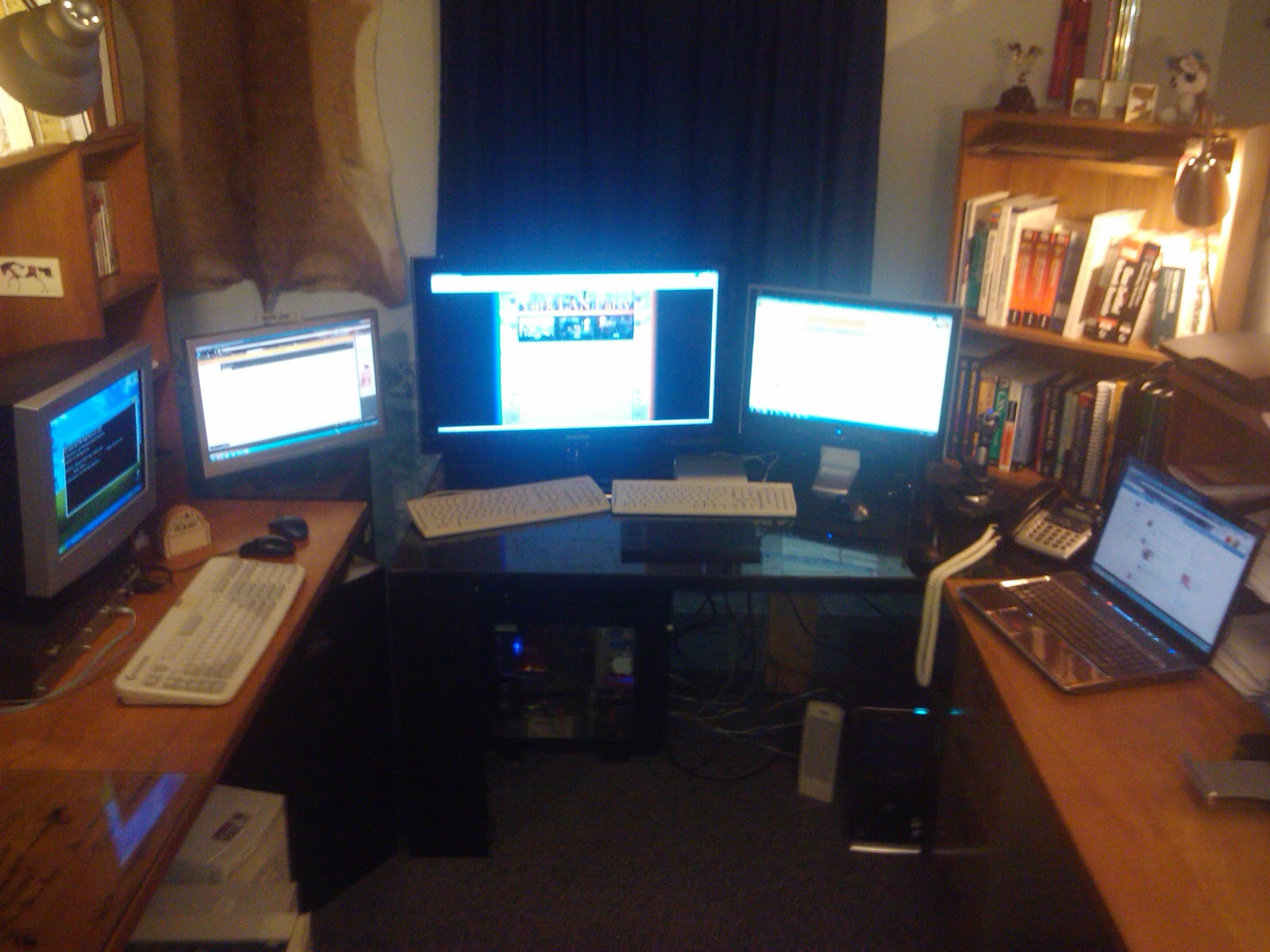
With an office like this one, and a whiteboard full with a list of projects, information overload becomes a real possibility. Not surprisingly, the subject does not get much attention, and few people consider it a very important subject. There is however some research done about it by many different fields of study.

The first thing to understand is that the only way you can have information overload is if you have decided to take in too many pieces of information at the same time. To make this a little clearer, imagine you are not an air traffic controller and you walk into a control room full of radars and radios. You won't experience information overload because nothing around you makes enough sense for you to begin processing all the pieces of data that are actually available.

If you were to become an air traffic controller and then walk into the same room, you could have information overload because you would have the ability to understand ALL the information that is available. It's only when you TRY to understand everything at the same time that it becomes overwhelming. In other words, it only happens when you let it happen. Air traffic controllers, much more than the average person, must understand how to handle many different pieces of information at the same time.

From a psychological standpoint, it is actually a form of anxiety. The solution is our approach and our attitude to the information we are given. This is something I was never very good at to be honest. It all comes down to being able to decipher what we actually need to know and what exactly to do with that information. By completing tasks, we eliminate one by one the information that we need to process and can then move on. When faced with many different pieces of information, break it down by priority and begin to eliminate as much as you can as quickly as you can.

On the other side of the coin, preventing information overload is just as important. By selecting smaller groups of information to start with, we can make it much easier to handle.

There really isn't as much on my plate this year as there have been other years. Between photography, web design, my studies, church, health, Moss Effects, the groups in Central PA that I'm involved in and Hot Air Balloons, I still should have plenty of free time. How? Let's say I take 4 pictures a week. 4 good pictures that is. It should take me 4 or 5 short photoshoots to get those 4 pictures. If a typical photoshoot takes between 15 and 30 minutes, it should only take an hour or two a week to get all 4 pictures, but the amount of learning and experience will be immense!

Applying this philosophy to every area outside of work has already proven to make so many more things possible that I had ever imagined. This year, my goals are all achievable, and as long as I stay focused, so are the goals I set on this blog a few years ago.

Thursday, December 29, 2011

Quality of life is exponential, begin to pursue wisdom, and the rest will follow.

This year, instead of an elaborate new years resolution, I get the chance to move from one world to another. My last day at Sunoco is New Years Eve, and my first day at Architectural Testing is the 3rd of January. As one door closes, another opens and I begin to develop my self and my skills in a new direction.

This phrase dawned on me today as I began to ponder this massive change in my life. Whatever our goal, whatever our purpose and passion, that will be our end. If we simply try to be orderly, clean and stable, that will be our life. If we slack in any area, it will be exponentially detrimental to us because it will carry over into every other area of our lives.

If we simply pursue a clean, healthy and orderly lifestyle, every part of our lives will be touched by this pursuit.

Let that be your resolution for the year 2012 as it is mine.

Saturday, December 10, 2011

What happened to the story of Christmas?

It's a typical setting on a cold December evening, as people gather around a small nativity to hear the Christmas story once more. Mary and Joseph travel from Nazareth to Bethlehem, a town very foreign to them. They knock on the doors of every inn they can find, and there is no room anywhere to be found. Finally at the last inn they check, the innkeeper says in disgust, "well, I don't have any room, but if you want, you can stay in the stable."

It's a quaint story, full of sentimental value and focused on love and kindness, the birthday of the King.

But wait! Where did this all come from? Did it all really happen this way, or have we simply passed on a story from generation to generation? Well, some of this story is true, because it is based on something that really did happen. But it has been brutally twisted, leaving out some of the most important parts of the story. After some serious study, the following is what I believe to be the real story of Christmas:

Mary, an insignificant young lady, who cared about the things of God and was willing to do whatever He asked, was informed one day from an angel that she was going to have a child who was conceived of the Holy Ghost. The man that she was betrothed to, was informed in a dream from an angel that he was to marry her and that she would have a son whose name was to be Jesus, for He would save His people from their sins.

   Speculation: It was likely that Mary's family and some of her friends thought she had committed fornication and was going to have a baby by someone other than Joseph. The only scripture to back up this speculation is that Joseph was minded to put her away privily. This indicates that at least Joseph was aware that she was with child, so it is also possible that no-one else knew this, or other circumstances corrected for this misunderstanding... however, this is not as likely.

A direct route from Nazareth to Bethlehem is roughly 90 miles. However, there was a problem with this route for the Israelites in the first century and a long time prior; this would have taken them directly through Samaria. Israelites hated Samaritans and so, would have traveled 120 miles and bypassed Samaria altogether. A caravan of this time period would have traveled about 20 miles a day, meaning Mary and Joseph would have been traveling for 6 days to make the trip.
 
There is no mention of a donkey in this story in scripture or any other historical documents. Caravans would have charged a fee to join them, and this could include the ability for Mary to ride in a cart. Otherwise, she would have walked.

Although Joseph was a carpenter by occupation, he was apparently not very wealthy. How do we know this? In Luke 2:24, Joseph and Mary offered the poor sacrifice, "And to offer a sacrifice according to that which is said in the law of the Lord, A pair of turtledoves, or two young pigeons." This references the law in Leviticus 12:5-8 regarding the sacrifice "when the days of her purifying are fulfilled". Verse 8 says, "And if she be not able to bring a lamb, then she shall bring two turtles, or two young pigeons;"

The word "turtles" in the English JKV is really an abbreviated translation for "turtledoves". This is more evident in the Catalan Trinitarian Bible Society translation which uses the word "tórtores" in both Luke and Leviticus. The Strongs concordance confirms the meaning of this word, תּור tore
which is translated "turtledoves" in several other places in Leviticus.

This means Joseph likely would not have been able to afford a donkey or cart of his own.

Now we come to a very odd distortion in the story, the reason for the trip. This requires some background.

Caesar Augustus could possibly be considered the most successful ruler in all of history. His reign began at a time when the roman empire was in collapse. There had been civil wars, assassinations, and many other demoralizing events throughout the empire. He was able to start with the kingdom in that condition, and bring order and power out of it, establishing both a very solid economy and military. [1]

Caesar Augustus mandated two census', also referred to as worldwide taxes. Luke 2:1-5 explains that Joseph went to Bethlehem for a taxing which was first made when Cyrenius was governor of Syria. Cyrenius was the governor of Syria during the first of the two census' by Caesar. [2] Joseph went to Bethlehem because he was of the house and lineage of David. It is possible then that Joseph had family in Bethlehem, because that was the point of the trip, to go to the town of his heritage.

Caesar was a good emporer who had helped the economy in many ways. This taxing was not overbearing, but rather was more of a census. This required people to go back to the home of their lineage. Rather than people hating this census, it is more likely that the general population was in favor of it. It is hard to say without further research into this time period and the history of Caesar's reign.

Mary and Joseph were both descendant from David. Matthew chapter 1 shows the lineage of Joseph, and Luke chapter 3 shows the lineage of Mary. We know Luke is speaking of Mary, because it says in verse 23, "And Jesus himself began to be about thirty years of age, being (as was supposed) the son of Joseph, which was the son of Heli," As usual, the Catalan is much closer to the original text in this verse, saying "de Josep, d'Helí". The words the son are not in the text, but rather it simply says that Joseph was 'of Heli' which could mean he was the son in law of Heli. Because the Matthew account specifies that "Jacob begat Joseph" we know that Luke is showing the lineage to Mary.

Joseph was a descendant of Solomon, and Mary was a descendant of a different son of David, Nathan. There were 28 generations between David, and Mary and Joseph, so they were very very distant relatives.

After a 6 day journey, Mary and Joseph needed to find a place to stay. They would spend at least 2 years in Bethlehem before making another journey. Luke 2:6 "And so it was, that, while they were there, the days were accomplished that she should be delivered." There is no reference that specifies how long they were there before those days were accomplished, but it does indicate that they had a few days to settle in before Mary had the baby.

Luke 2:7 "And she brought forth her firstborn son, and wrapped him in swaddling clothes, and laid him in a manger; because there was no room for them in the inn." The inn, κατάλυμα

From καταλύω; properly a dissolution (breaking up of a journey), that is, (by implication) a lodging place: - guestchamber, inn. (Strongs Concordance)

A lodging place or guest chamber. The term in Luke 2:7 is singular; there was only one place that was considered. No more details are given, so this part of the story is left to speculation. We know that there wasn't such a thing as a hotel in those days, and Bethlehem was not a very large town. Did Joseph or Mary still have relatives living in Bethlehem? It is very possible, but 28 generations had obviously spread people abroad. This guest chamber could have been in the house of a relative, but again, this is only speculation.

Now we come to the most important part of the story; the part that has been lost in time.


Luke 2:11-12 "For unto you is born this day in the city of David a Saviour, which is Christ the Lord. And this shall be a sign unto you; Ye shall find the babe wrapped in swaddling clothes, lying in a manger."

Which manger? There were certainly many mangers throughout Bethlehem. How did the shepherds know where to go? There is no record of the angels telling them where this would be. This is where we have to look at the part of the story that is taken out; the record of the birth of Christ, by Micah.

Micah 4:8  "And thou, O tower of the flock, the strong hold of the daughter of Zion, unto thee shall it come, even the first dominion; the kingdom shall come to the daughter of Jerusalem."

What was Micah talking about here? In Micah 5:2, just a few verses later, "But thou, Bethlehem Ephratah, though thou be little among the thousands of Judah, yet out of thee shall he come forth unto me that is to be ruler in Israel; whose goings forth have been from of old, from everlasting."

Micah is explaining in detail where Christ was to be born. The tower of the flock, מגדּלה עדר   migdâl ‛êder. There is a real tower, standing today on the north side of Bethlehem, facing Jerusalem, known as Migdal Eder. This tower was the place where sheep who were about to lamb would be brought to give birth. These lambs were the lambs intended for sacrifice in Jerusalem. The perfect, unblemished lambs were wrapped in swaddling cloth to protect them from hurt, damage, blemish or injury.

Where else in the world would be a more perfect place for the perfect, sinless Lamb of God to be born? Wrapped in swaddling cloth, as a sign of the purpose of His coming, born in the same manger that many sacrificial lambs were birthed.

How could this vital part of the story be left out? Why has the story changed so much from what we are told in the scripture? The traditional story tells us of the birth of Christ, of the angels and the shepherds, and of the glory and praise that was given to the newborn King. What it doesn't tell, is why He came. By leaving the tower of the flock out of Christmas, the purpose for His coming can be forgotten. You see, we've taken the cross out of Christmas.

Jesus Christ was born to die. He came to give His life for our sins and free us from the bondage of sin - death and hell. In even more significance and quaint sentimental value than the story we were told, He came as a Lamb for sacrifice.

This Christmas, let us not forget the most important part of the story: why He came.

Tuesday, November 30, 2010

Awareness

     There is a concept that is foundational in the thinking of the greatest martial artists, spies, athletes, security professionals and criminals (as well as several other key occupations).  I'm not saying I would ever become a criminal, but I'm also not saying it would be a bad thing to understand their thinking.  If a person can think like a criminal, they can protect themselves and the organizations or people they work for.. not to mention their own families from becoming the victims of a criminal act.  But it might help to focus on the other occupations, just because.
      So what is this all empowering concept?  The title of this post? Ok yeah I could have been a little more creative, but there's more to it than just being aware.  Ignorance is not bliss, at least for any professional martial artist, and perhaps some insanely geekish black hats.  But what in the world do we need to be aware of?


            EVERYTHING


      Make sense yet?  How about an example: a Russian spy working in the United States is walking home from his cover job on an average day.  He turns a corner and notices that a man in a black suite is carrying an M9 handgun in a shoulder holster.  If the spy was not able to differentiate between an M9 and a Beretta 92 (something I must admit I would have no clue how to do), there could be some severe consequences... the M9 is military issue and the Beretta 92 is not.  That piece of information could be key in identifying the man and remembering the face.
      That might be a very bad example, but it gives you an idea of how a spy could benefit from knowing a seemingly random bit of information.  Its not as random as it might seem, although there is a lot of information to sift through depending on your target field.  Everyone can benefit from becoming more aware.  Its simply a matter of choosing the right target area.
      If you want to learn something, it is best to familiarize yourself with the surrounding field before jumping knee deep in studying the wrong thing.  Programming is the best example of this.  If I want to learn to program, I must first choose a language that I plan to study.  Making this choice can be difficult when there are so many languages in use.  If I first find a decently comprehensive list of all the best programming languages, and then gain an understanding of the ways that each language is used, it will be a relatively easy choice.
      Another simple example: Information Technology professionals benefit from knowing hundreds or even thousands of acronyms for protocols and technologies. Why?  Not only will they be able to understand the day to day operations of their own job better, but put them on a brainstorming team for a new project, and they will blow the minds of their colleges because they know exactly what the best solutions might be, and they'll know why.
      For someone like me, who wants to delve as deep into as many subjects as I can, becoming aware of many things is important.  There are some exercises that I've developed to help me become more aware of everything around me.  When I'm riding in a car (or sometimes driving...) I will choose a particular part of a car, say the bumper, or the door handle, anything really.  Then I look at that part on every car that passes by.  This exercise helps me become more aware of every facet of the design of cars.  Sometimes now, all I need to see is one part of a car and I can tell you what make and model it is and approximate the year.  This usually comes naturally to mechanics or auto body specialists, but when you're not actively working in an industry, it's a little harder to keep up with it.

    Know of any good ways to become aware of specific things?  What things are you more aware of than the average person might be?
     

Monday, November 29, 2010

Progressive Organization

     Well right now, this office is an absolute mess; and for a lot of people looking to start getting a little more organized, there is a TON of clutter getting in the way of what's most important to them.  For me, having a place where I can be creative, find answers at my fingertips, and do extensive brainstorming  is something that would be invaluable. My office is where I can do all that.  The problem is, there are so many papers and CDs and ancient electronics scattered everywhere, that I've become somewhat hindered from being able to do all that, as freely as I would like.
     Recently, I discovered a very inspiring instructor from the University of New South Wales through youtube.  His entire lecture series on first year programming is available there on youtube.  His name is Richard Buckland if you care to know.  Anyway, in following a few of his lectures I came across lecture# 24: eXtreme Programming.

     What is eXtreme Programming?  Simply put, it's a methodology for the organization and implementation of programming projects.  It sets in motion a more powerful way to take control of complex and rapidly changing environments.

     This evening, instead of tackling the 15 some odd things on my to do list, I decided to figure out if there might be a way to use some of the theories I learned from eXtreme Programming to develop a methodology for organizing the crazy variety of topics and office related files in my room.

     So here it is: something I'm calling Progressive Organization. Please keep in mind, this is only a theory and I am just now starting to test it. (There may be other things labeled progressive organization, or it may already have books written about it' I'm really not sure.. so don't consider me the authority here, but I didn't reference any material to come up with this.  This just came off the top of my head.)

     There are 5 basic steps in this theory:

          •  Clean - Clear away the clutter
          •  Design - Define the functions of each area
          •  Target an area - Focus your efforts
          •  Develop a plan - Make a single area work well with all it's functions
          •  Carry out the plan - Don't just sit there! Get to work!

     Ok so now that I've completely bored the average person out of their mind with the basic gobbledygook, what does it all mean?

Clean
     Get rid of EVERYTHING that does not have a specific purpose.  This part I know works very well because I've used it before.  Find a place to temporarily drop things, a place somewhere that things won't be in the way.  Then begin moving everything you aren't using, or aren't planning on using out of the area or room that you are organizing.  Put stacks of papers in boxes to go through them later, pick up everything that you don't have a place for and move it to the temporary storage place.

Design
     Now you should have a pretty clean environment to work with, but you may not have long to get things working depending on where your temporary storage is, so you might have to get to work with the next few stages.  The design stage is where you will break down the functions of each and every part of the room.  This can be done in your head, or written down if you prefer.  The idea is to know exactly how the room will function.  Think of everything that comes in and everything that goes out.  Have places for everything you can imagine you would need a place for.

Target an area
     Pick one function and develop it.  Say for instance your mail:  mail comes in, typically a small stack at a time, gets opened, and some gets stored and the rest discarded.  This is one function.  There are many functions in an office, and every room of a house usually has multiple functions when you think about it.  A kitchen has a cereal function: buy cereal, store cereal, eat cereal, discard cereal, and at some point in time, you write down the particular cereal that you need to buy because you're getting low... and the cycle starts over.  At this step (Target an area), you must choose a particular function, and begin to make it work.  Which brings me to the next step.

Develop a plan
     So you picked the filing system.  Good choice☺  That's what I started with too.  So now it's time to make it work.  But there's so much to it!  How can I organize so many different papers into files and folders and categories???  This is why development is it's own step.  Some functions only need a little thought and you'll have it working and get very excited about implementing it.  Other functions you might dread even after you've figured out how to make it work.  In the case of my filing system, this stage is much like designing a database... very tedious and annoying.  I grouped my system into four categories because that's what made sense for the kinds of papers I will be filing.  Business, Records, School, and Study.  Business will be anything to do with web designs or projects or even this blog.  Records will be any records, receipts, finances, school stuff etc.  School is self explanatory and study is any experiments, research, thoughts and ideas that might pertain to something I'm learning.  The file system will get broken down further in the next step.

Carry out the plan
     See, I already procrastiNATEd... the file system should have been broken down in the development stage... but here I am standing in front of my filing cabinets thinking of how exciting the next episode of Burn Notice will be, and how much more fun it would be to watch it on Hulu than it would be to actually figure this out.  This stage is by far the most difficult for me because I'm easily distracted.  This stage is all about follow through.  What good is a fully developed plan without ever putting it in action?  Ok so you have a great idea and it can be used for theory to help someone else do something better.  But who will consider your ideas if you never succeed?  In order for anything to work, there has to be work and effort behind it.  A great mechanic once told me, WAKE UP! This is reality! Get to work and quit wining.  Life isn't a free ride, you have to push to get things done. (not in so many words), but that helped me to see that priorities and dedication are key to succeeding at anything, even if all you want to do is support and raise a family in a decent neighborhood.

     Once you've gone through one itteration of this process, you begin again.  For long term projects, you start at the beginning.  For short term projects, you start at step 2 or 3.  The process continues until you have a very well working system.  Then you can continue refining your functions to infinity, which may help at first, but it could hurt your system in the long run if you delve too deep into every specific movement of a particular room or process. (I hope that made sense...)

     Progressive Organization is intended to flow and be flexible enough to deal with complex organizational issues. So what are your thoughts on this idea?  Is it close to anything you've read before?  Do you have better ideas?  Please share them in the comments.

     After a little of the first step... here's a pic of my office.  Keep in mind that in order for everything here to work well, there is more than just looks to consider.  Organization and implementation are key to making my world tick.

Saturday, May 22, 2010

Learning beyond

I have turned a page in my life.  I've made the decision to focus on studying even more than ever.  This means less time for friends, family, recreation and hobbies.  The reason for this is the sheer scale of information that I want to learn.  The motive is a passion for the subjects that I'm studying.
   I've broken my study into four groups.  Stewardship, Guruship, Study A and Study B.

Stewardship - From a Biblical basis, the concept of a steward of the Lord.
  Studies include
       • Memorizing Bible verses
       • Studying concepts in the Bible
       • Preparing Bible stories and lessons

Guruship - A combination of a guru in a technical sense, and a guru from ancient martial practices.  One who holds knowledge, a student on his way to mastering a concept studies under a guru.  Guruship carries the concept of a journey or a path to becoming a guru.
  Studies include
        • Logic
        • Mind Control (may change to psychology at some point)
        • Writing skills (music, lyrics, poetry, speech)

Study A - Foundational study.  Subjects that are considered essential in certain fields.
  Current study includes
        • Computer Hardware Fundamentals for CompTIA  A+ certification
        • Website design fundamentals currently focused on Javascript

Study B - Extracurricular achievement.  Subjects that will help build a solid future.
   Current study includes
        • CISCO
        • Design (currently focused on AutoCAD)

    One thing I have learned about studying in the past few months is the need to be focused on a single subject at a time.  So, to reach a goal as diverse as mine requires some out of the box thinking.  By breaking the subjects into categories, it is easier to focus on one category at a time.  One day I might focus on study A, and even though there are two separate subjects in study A, they work together very well and it is easy to jump from one to the other.  If I was to study CISCO and computer hardware in the same day, (unfortunately this is the schedule at school) I would be focusing on two different subjects with similar content at the same time. This has proven very challenging.
    The same would go with studying Web and Design.  Web incorporates design, so the ideas would overlap and become confusing.  Fortunately, it is easy to study both stewardship and guruship along with one of the study categories.  These are dissimilar concepts and work well together.

    How do you study?  What ideas have you come across or developed for making studying easier?  Please share in the comments!

Friday, March 5, 2010

Å └ ╦ Ç σ d ë §

The title of this post was written on an English keyboard with an English keyboard input and with no html configuration.  How?  Using alt codes.  There are 253 different characters available.  They are all listed at alt-codes.net.

You're probably all familiar with them... but what can you do with them?  What's the point?
▒▒▒▒▒▒▒▒▒▒▒▒▒▒▒▒▒▒▒▒
Obviously I wouldn't be writing an entire post for alt codes if I didn't feel there was something special about them.  Honestly, I think they are often overlooked as a useful tool.

Some benefits of using alt codes:
  •you can use alt 7 to create unordered lists like this one.
  •numbers 179 through 223 can make drawing.
  •special characters like the sun ☼ or smiley faces ☺☻ are easily accessible.
        ○ numbers 3 - 6 are ♥ ♦ ♣ ♠.
        ○ mathematical symbols are available √ ≈.

In the good old days of DOS, programmers would use these characters to make the interfaces for their programs.


   ≡≡≡≡≡≡≡≡≡≡≡≡≡≡≡≡≡≡≡≡≡≡≡≡≡≡≡≡≡≡≡≡≡≡≡≡≡≡≡≡
  ╔════════════════════════════════╗
  ║                        HELLO WORLD                          ║
  ║                                                                        ║
  ╠════════════════╦═══════════════╣
  ║                                    ║                                       ║
  ╚════════╤═══════╩═══════╤═══════╝
                              │                                         │
                              └───────────────┘

Obviously this is not as dynamic as it could be (only part of the 'window' above lines up if you're lucky),  but for it being text only you can really do some incredible things.  That's why I've determined myself to memorize all 253 of them.  At the time of writing this I'm up to 63, and I've already found use for them!
  Ok so maybe memorizing 253 characters and the numbers associated with them is a little over the edge for most of my readers, but I encourage you to at least learn the ones you think you will use, like 7 •  9 ○  26 → and 27←.
  What other types of keyboard shortcuts do you use on a regular basis?  Please share in the comments!

Friday, February 26, 2010

Binary Intelligence

  On August 31st, 1955,  John McCarthy, Marvin L. Minsky, Nathaniel Rochester and Claude E. Shannon introduced a proposal for a summer research project on artificial intelligence.  This was the first time that a reference to the idea of artificial intelligence can be found in modern history.
  Ever since then computer scientists have been exploring the possibilities of artificial intelligence (AI).  There are now many companies dedicated to just AI.  In fact, you may not be aware of just how often you already encounter it.  Games like Sim City (yes, the first one), Total War and Halo have made huge advancements in AI. All of these games have been very influential in the development of AI.
  Before I get into the ins and outs of intelligence and my views on creating thinking machines, there is some groundwork that I want to lay.  There are several divisions or categories of AI that are typically researched.  The main categories according to John McCarthy are logical, search, pattern recognition, inference, common sense knowledge and reasoning, learning from experience, planning, epistemology, ontology, heuristics and finally genetic programming.  It is my opinion that the most fundamental category of AI is often forgotten or left out, and that is creativity.  A creative artificial intelligence would be capable of making new intelligences, as well as advancing technology in ways previously unimaginable, even in science fiction.


  Noah Websters 1828 dictionary defines intelligence as, "Understanding; skill."   An intelligence can also refer to a being, as the same dictionary also points out, "4. A spiritual being; as a created intelligence. It is believed that the universe is peopled with innumerable superior intelligences."  Unfortunately, it appears that most of the energy in AI points toward the second definition rather than the first.  Even efforts to program creative AI still focus on the idea of replicating part of human intelligence.
  Most AI defies any sense of moral law, and in an attempt to ignore the presence of God, tries to replicate a consciousness.  The idea that man can create a being capable of thinking, learning and even creating on it's own defies God.  It is built around the idea of evolutionary theory, and assumes that humans can become godlike.  The game Black & White is a horribly perfect example of this.  As a result of such beliefs, the idea of working with AI in any way shape or form is a very tedious task, and requires very careful attention to detail. 

  We as humans can't be expected to understand everything a computer can, or to be capable of making any where near similar calculations.  This fact is easy for us to grasp.  You wouldn't remember every cell of a one hundred row by one hundred column spreadsheet, or be able to draw it from memory.  Grant it there are people with photographic memories, and they do have computer like abilities, but there are other calculations that computers make, such as GUI or OS related operations, that humans are very slow at.
  Once you get this fact, it becomes natural to understand that a computer is incapable of understanding things in the same way that humans are.  As far as we know, brain cells do not work in binary.   Until we know exactly how a brain works (something I don't think is possible) we will never be able to duplicate it electronically.
  So where am I going with this?  It's an article on Artificial intelligence, but I just claimed that it's not possible!  Or did I?
  The foundation of modern exploration on artificial intelligence focuses on human, or animal like intelligence.  The goal that has been set by the leaders in AI research is to achieve human like intelligence.  To me this is absurd.  What kind of intelligence is a computer capable of?  A computer understands things to be either truth or error, on or off, yes or no.  If someone could figure out how to give such a machine the ability to create, the possibilities become endless!
  It is my belief that computers are capable of much more in the way of intelligence than we give them credit for, and yet the drive of almost all AI development has been to duplicate a kind of intelligence that we know computers are incapable of.  We know computers are capable of some learning, some pattern recognition, and a type of logic.  Let us now pursue the ability to create, not based on the idea that man can become a god, but based on the idea that we now have a technology known as computers, and we have the responsibility given by God himself to be good stewards of these resources.
  If a group of individuals can make a program with creativity based on these concepts, there is a good chance that it will be capable of creating things that us humans could not even dream of.  So what are we waiting for?

Tuesday, January 26, 2010

Logic - the key to true understanding

  In the quest for knowledge, there is one concept that stands as the most important.  Without it, truth would cease to exist, ideas would have no meaning and character would vanish along with any moral law.  The past few months I've been taking an in depth look at logic using a curriculum written by Daniel Valles.
  The Art of Logic focuses on building concepts about logic, starting with the simplest and working toward the more difficult.  The series of 41 lessons uses a workbook and each lesson has it's own video.  One of the advantages of this course is the fact that much of the material refers to scripture using the KJV.
  Much of the understanding of logic that Valles comes to is derived from Isaac Watts book Logic. 


  I intend to continue to study logic beyond this course and Isaac Watts' book.  Some of my more recent thoughts have come out of this study, such as a theory for a creative artificial intelligence engine which hopefully I can talk about in a future post.
  Know of any good sources for the study of logic?  Please comment!

Saturday, January 23, 2010

Visio


  I was first introduced to Visio, Microsoft's layout and flowchart application at the beginning of this term in school.  It allows you to very easily make layouts or designs of just about anything!  The seemingly limitless possibilities of this program made me practically fall in love with it.  You may even see me use some pictures taken from it as profile pictures for this or that.
  So what can you do with it?  You name it!  Design your dream house, layout a new computer application, design a website or even create a new circuit board.  I learned how do to some of the more advanced things from visguy.com and some other tutorials online.  Once you get it, it becomes very easy to duplicate things.
  My main term project is being done in Visio.  I call it Rigor.  It is a topology of my school.  for those of you that have Visio, I'll let you know when I'm done and I'll be posting a link so you can download the finished project at some point.


above: my dream office :)

A status webapp for Geeks

  Some people have more than one computer!   Some have up to three or four that they use on a daily basis.  So what do we do when we have 10 people to talk to, and we're on 2 out of 3?  I think us hard core geeks need a new web app.


  This application would be web based and be located at a single url... then you could install gadgets for facebook, twitter, and other profile pages, which automatically update in an increment that you define.
  Ok so here's how this works...  when you set it up, you configure each computer you use, then the application knows when you're online and with which computers.  It also knows what applications you have running, so like say you're on facebook but not MSN messenger, anyone that sees this app will know where you are.  You could also set priority levels on separate applications, so say you like Skype more than AIM, people would know what you prefer, and if they have it, probably use it first.
  Is it a good idea?  Would you use it?  Or better yet, if someone else had it, would it effect the way you communicate with them?

Sunday, December 13, 2009

Limits

  It is a goal of mine to learn some specific things in the next 10 years.  It just so happens that I tend to spread my interests over so many things that when people ask me what I'm into, it usually takes me more than a few minutes to recall them all.  There are some obvious problems with this, particularly when setting goals about what to learn and when.
  The number of things on my list of things to learn in the next 10 years is currently up to 20.  Craziness I know, but if I don't set the goal, I'll never reach it.  Below is the list, in the most logical order I could come up with:

  • IT (Information Technology)
  • Bible
  • Logic
  • Business
  • CAD
  • Drafting
  • Fashion
  • Engineering
  • Fabrication
  • Metalwork / Woodwork
  • Mechanics
  • Survival
  • Martial Arts
  • Dirtbikes
  • Medical
  • Aviation
  • Aquatics
  • Music
  • Linguistics
  • Programming
  Why so many things?  How do you honestly expect to learn all of this.  Is it possible?
  That's the biggest question!  If it's not possible, then I guess I'll just have to wait for God to help me through whatever changes He decides to make.  You see, I feel that this list is not something that I was inspired to make on my own, but that God has had a big part in it's inspiration.
  I believe that I was called into the ministry to become a missionary pilot / board director / linguist / see list above, in south eastern Bolivar in Venezuela.  I feel He would have me start from scratch and organize a brand new mission board.  This kind of task requires certain skill sets, which I currently do not have.
  One morning, I sat at the river bank of the Susquehanna watching the sun rise.  I was tired and ready for bed.  I had just finished working third shift at Tom's convenience store.

  My life was busy; too busy.  I hadn't stopped to reflect on anything in months.  The continuous work and stress had me dull and mentally congested.  In the solace of the moment, I prayed.  I knew I needed to make some changes, because things were all adding up to being just to much for me to handle. In my prayer I asked for wisdom.  Not just wisdom in general, but a very specific kind of wisdom; the wisdom of organization.
  At that moment I felt a peace come over me.  With new ambition, I got up and went home to get some sleep.  Organization means something different to me now than it did before that morning;  it means fulfilling God's plan for my life.
  So is it possible to learn 20 completely different fields of study in 10 years? 
  Ask me in 10 years :)

Thursday, December 10, 2009

The Perfect Workspace

  It has always been a dream of mine to build an office that was absolutely ideal.  Impossible you say?  Well first take a look at some of these work spaces!
  The Emperor 200 workstation from Novel Quest is probably the most ergonomic chair ever made.

It features three 19 inch LCD displays, a control screen at the fingertips of your left hand, a 5.1 surround sound system, fully adjustable seat, tilting and rotation, multiple working lights, filtered air conditioning and a built in webcam and microphone.
  Is it ideal?  Almost, but what if you decide you want to print something?  What if you want to scan files into a computer and organize them into a printed album?  The emperor is almost perfect for a lot of purposes, but in my opinion it doesn't cut it when it comes to the perfect workspace.
  NovelQuest has just recently release a new version called the Emporer 1510.


  Some computer savvy 'geeks' or programmers have built their own workstations in their homes that do as much or more than the emperor!  In this picture, a web developer uses this desk to do all his work.  Notice the computer picture frame on the wall.
  There are some things that I would like to incorporate in my workspace in the future.  Some things that are very important to me are ambient lighting, temperature control, screen space, shelves and filing cabinets to keep clutter down and it's always nice to have a little refrigerator on hand to put snacks and drinks so you don't have to walk all the way to the kitchen :)
  Below is my current workspace.  Always a work in progress, it includes some of the features that I consider ideal.  Green ambient lighting and 3 screens if you include the laptop.  As for temperature control, if I turn on all the lights and have all my computers running (there are some project computers on the back desk) the room warms up very quickly, large replacement windows provide good ventilation and cooling.  Not the best way to control temperatures, but it works.  There are plenty of shelves and desk space to keep things from getting scattered around the room (although i still find ways to make a mess). 

  I don't have a refrigerator, but I can't complain!  This workspace works pretty well for me and does everything I need it to do.  It is not what I would consider ideal, so it is continually expanding and I have plans for the perfect workspace, which hopefully I can build someday.

Monday, December 7, 2009

Language Schedule

  In my quest for learning, language and linguistics is among my favorite topics.  There are several languages that I would like to at least be able to communicate in by the end of my life.  I would like to learn Spanish, Catalan, French, Italian, Portuguese and a native South American language in that order.  This quest is life long, and I understand that.  I spent 3 months in Spain, 3 weeks in Equador, and some time on my own studying Spanish and Catalan.


  This undertaking is definately going to need some help.  I don't have very much time, so my thought was to have a monthly calendar for what to learn.  For instance, the first week of the month, I would learn the name of the month in my first language.  The second week, I would learn the name of the month in my second language and so on.  Days of the week would then be broken down into different subjects.  Monday might be focused on food.  Tuesday might be office things.
  I think this is a system that could potentially be developed into something very powerful.  It is however very preliminary, and really could use some suggestions.  Have you learned another language?  What do you think of this idea?
  I have tried some things similar to this already, but it seems the hardest thing to do is choosing words and finding an easy way to write them out or type them up without wasting time.
  Language remains one of my greatest passions.  The ability to communicate in another world, with a whole new culture, in a completely different tongue is truly beautiful.  The challenge of learning such a language is one of the things that draws me to it.  It can take a lifetime to learn how to best interact in a particular environment.  Thus the guru pilgrim continues his journey.

The Declutter Room

I had an idea about a month ago for a room in my dream house.  That idea has been the basis of a lot of thought surrounding organization.  The room, which I call the clutter room (or declutter if you choose), is simply a room that every new piece of paper, mail, or other odd object that causes clutter in a house, must enter before it gets put away.

  Why? you ask.  Well, if all the clutter is confined in one room, the rest of the house would be immaculate!  All that would be left to do is organize the clutter room.
  I currently live in two smaller rooms in my parents house, so I don't have the option of turning a room into a declutter room.  I do have the option of building as miniature version of a declutter room, a declutter table!
  What do I need for this?  The following is a list of the things I think I need to include.  What do you think?  Am I missing something?  Tell me in the comments.
  • Trash can
  • Place for a stack of full size sheets of paper
  • Place for unopened mail
  • A set of small shelves for stacks of little notes
  • A door on the bottom for a small storage compartment
  • Place for scattered pens, paper clips, pins, or other office related little things
  • Place or rack for CD's
  • Shelf for books
  • Several small compartments for change
  • The section for the undefined... a place to put anything that has no place
So how do you deal with clutter?  What are some ways to cut down on clutter without spending a great deal of time doing so?

Wednesday, December 2, 2009

Just an update,
   GuruPilgrim now has it's own domain, www.gurupilgrim.com.  In the process of making some changes to the blog, some of your posts were lost.  Please feel free to repost them!

Thursday, November 26, 2009

ThanksLiving

  Happy Thanksgiving to all.  This year, Thanksgiving means something to me that it never has before.  God has blessed us all in so many ways!  The past few months have been treacherous for me with school, work, karate, church, personal projects and maintaining some sort of social life.  This week especially is teaching me to stay humble and focused on what He would have me do.
  We as people get so engulfed in our lives that we overlook the little things.  Why don't we say thank you when we wake up to a beautiful new day?  Why don't we say thank you when we wake up to find it's one of the worst days of our lives?
  WHAT??? Did I just say to be thankful for the worst day of your life???


yes.

  God has a purpose for everything that He allows to happen.  And if you really think about it, the hardest day of your life actually did help you become a stronger person.
  What are you thankful for?  Just things like family, friends, relationships and turkey?  Or do you thank the Creator for teaching you and building you into the person you are now?

Tell what you're thankful for in the comments.

Monday, November 23, 2009

Ubuntu 9.10 is out!

  I just upgraded to Ubuntu 9.10 on my laptop.  It's truly amazing!  The last version of Ubuntu didn't find all the drivers I needed, so some of my favorite webapps like Pandora and Grooveshark didn't work.  The upgrade included all the drivers that were missing and my laptop now runs faster than ever!

   I've always been a big Vista fan, but after seeing what linux can do, I think I'll be delving into different distros and learning my way around.
  Catalan language support is great too.  All the menus and controls are translated well, which is something I've always wanted to do in order to help myself learn the language.

  Find out more about linux distributions and Ubuntu.

Friday, November 6, 2009

Unfortunately, they invented this thing called time...

  It's the first day of the term at YTI career institute here in York Pennsylvania where I'm taking a Computer System Specialist course.  Back to the hustle and bustle of a normal routine.  The problem is, I still haven't caught up with all the things that need to be done by the end of the week.
  Since technology began to boom in the early 1900's, it has become more necissary to develop time management tools and organization techniques.  GTD, or Getting Things Done is one of the many systems that has come about as a result of this need.  ZTD is a great system that fixes some of the 'problems' with GTD and offers another solution.  I have tried many times to find something that works for me, but the closest I ever came was a micro time management system that called for breaking down tasks into their smallest parts.  The inventor of this system would say 'I need to clean out my closet'.  They would then put on their schedule for a particular day "open the closet door".  Another day would be "take all the shoes out of the closet".  This may be a little extreme, even for me!  These tools and ideas did however give me good insight and got me started in learning how to really get organized.
  One morning after a long 3rd shift at work, I drove down to the riverbank to watch the sunrise.  As I sat there surrounded in the magnificent beauty that God created, I prayed and asked Him to grant me the wisdom and skill of organization.  I was reminded of the way that Solomon asked God for wisdom to rule his kingdom.  Then and there I knew that in time God would grant me that request.  Last night I worked the next step toward developing the system of organization that works best for me.
  Several months ago I decided I needed to develop my own system, so I made a spreadsheet online with the day broken into 5 minute segments.  Then during the times that I had to be productive I would write the list of things and estimate how long they would each take.  This might have worked except that the spreadsheet was terribly long, and there was no way you could get it all printed.
  This problem was not enough to get me to throw away the idea, because other than the fact that it was huge and hard to easily glance at, it worked!  Last night instead of going to that website to make up a schedule for the day, I made another spreadsheet and put it up on dropbox so I could see it from other computers.  The spreadsheet had only the task, the estimated duration of the task, and an empty slot for what time it was completed.  I decided this morning after using it that I should change it and make that empty slot have the estimated time of completion, which would act as a guide that I could reference to see if I'm ahead of schedule or not.

  The key to time management is to figure out what works for you.  Like I said there are hundreds of systems out there, so look around.  As time progresses I will most likely build on to this concept of mine of time management and I'll let you know what more I come up with.  Also as usual, comments are welcome!

Monday, November 2, 2009

GuruPages

I was up until after 2 this morning working hard for a few hours on version 1.2 of one of my websites, GuruPages.net.  My vision for this site has been consuming me for the past few months.  This is a website I'll be working on for the rest of my life.  The original idea was to provide tutorials and guides for free online for virtually any subject.  As the concept has developed, I've come to realize the vast possibilities.  Yesterday I came up with the inspiration of dividing each subject into topics.
  A topic will be a specific field of study.  Under each topic will be classes, usually numbered in the order that they should be completed or named based on their level of difficulty (e.g. basic, intermediate, advanced).  Under each class will be tutorials, guides, manuals, study materials, flash cards, self tests, tools and resources for learning that topic.  For instance you might have a topic named Spanish.  Under the Spanish topic you might have an introduction to learning languages class, a basic words class, a basic communication class etc.
  There will also be a way for you to log in and change settings, and at some point I would like there to be the control of changing color schemes to your liking.  This could be helpful for someone that wants to spend a lot of time working on tutorials or reading material because the screen could be set darker and darker screens are better on the eyes.

  I'll be keeping you posted on my progress with this as well as letting you know about other websites I build.

  GuruPages is an idea that I intend to keep as open as possible, and I plan to work with as many experts and professionals as I can to get things going.  This whole thing is still in it's very beginning stages, so if you have any brainstorming ideas or input as to features or layout or anything regarding GuruPages please let me know in the comments!